
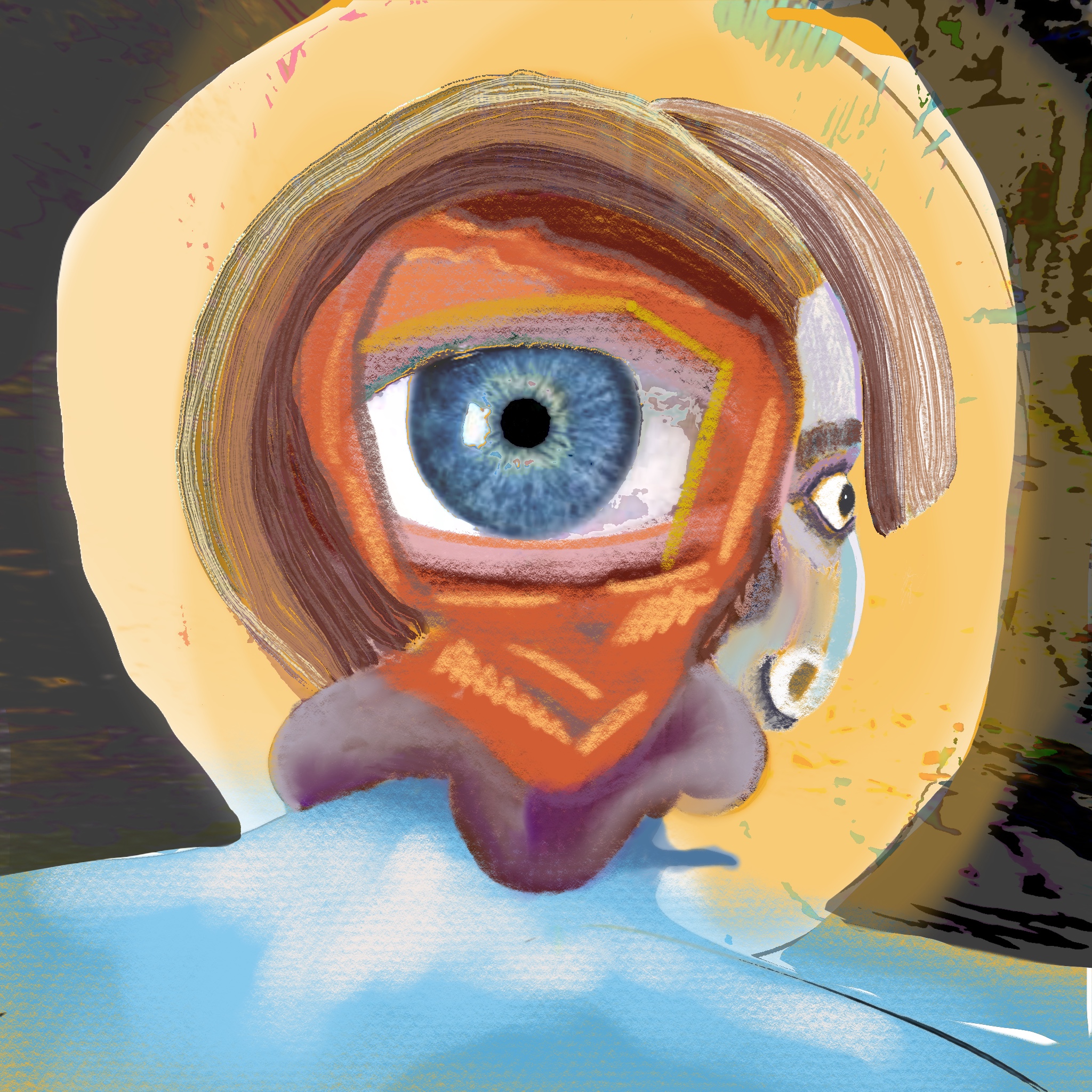
As a young adolescent, I remember sitting at the foot of my bed and writing in an early journal, “I yearn to be a poet.” These first visions of who I wanted to be in the world fueled a long love affair with poetry and language. I’ve continued to write, but haven’t thought of myself as a “poet” in a very long time. That’s like calling yourself “enlightened”: it may be trendy branding, but it’s also not true. On the other hand, I am sitting in front of my first book of poetry, Choreography of the Living, feeling humbled and proud. With hindsight, I can see how I heard the land speaking, and how poetry taught me the frame of mind to listen.
Walking and Writing
I lived in northern New Mexico for 6 years, spending an inordinate, daily time in various areas of the vast wilderness there. I would occasionally write when the spirit struck me. I was not trying to write poetry. In fact, if you were to ask me at the time, I would just say I was “listening,” which in this case meant I was hearing what that land was speaking.
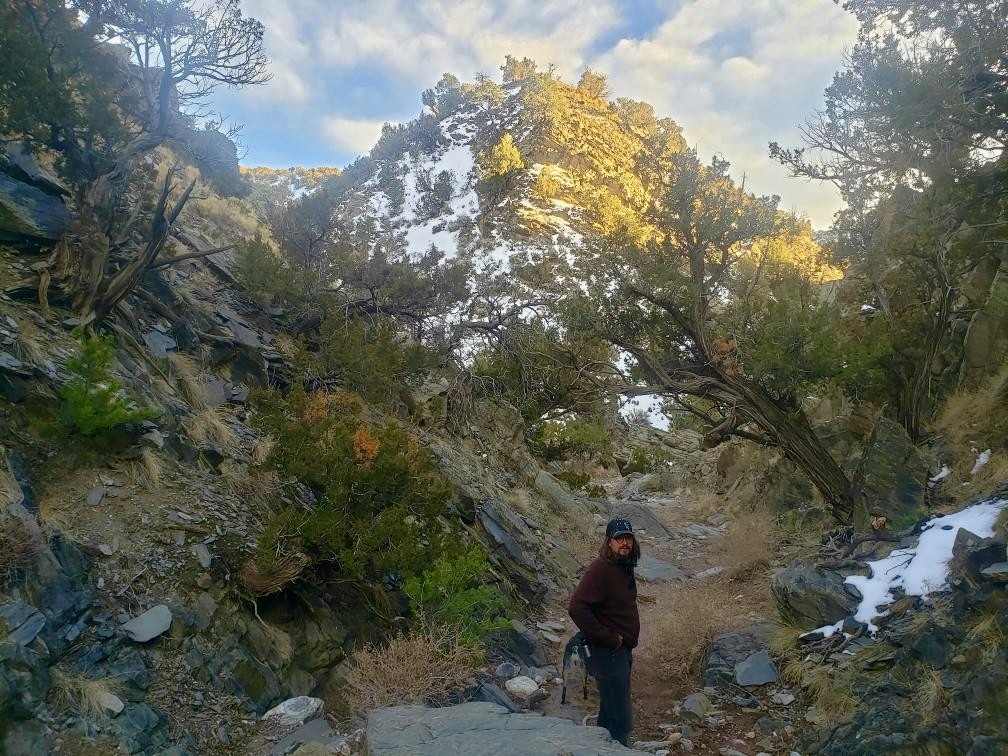
“Hearing” isn’t exactly right, either, because I wrote what I felt. Knowledge doesn’t just come through thinking — the heart, the gut, and the body have their own wisdom. So the writing is a translation not only from “nature” out there, but “nature” inside, my own body humming along, alive, a part of the living world.
“The voices” that speak through the land are literal, but they do not communicate in words. The trees speak in a language of smells, chemical signals, and fungal networks. We can apprehend some of these elements, and, especially when you’re with these living entities, they have a sort of spirit or living quality that communicates. Maybe that’s the great feeling of being outdoors in nature, one voice among the great polyphony of voices interacting with each other.
Polyphony is a word Merlin Sheldrake uses in Entangled Life to describe the nature of living systems. We tend to assign “living” to individuals: that tree, that doe. In fact, while the individual aspen tree or deer is certainly alive, it may be more accurate to understand the entire grove or herd as alive, a continuous living entity that regenerates through the growth, death, and birth of individual members. No one individual can perpetuate itself without the collective.
It may be even more accurate to say the entire mountainside functions as a skin of living tissue, and that all life, including humans and human society, is one instance within this larger ecosystem.
El Norte
The people of New Mexico call the entire area “el norte” and, themselves, “norteños,” denizens of the distant, high-altitude reaches of the old Spanish empire. You can picture the entirety of northern New Mexico and southern Colorado as a huge valley between two mountain ranges on the west and the east. The whole structure gains altitude as it moves north, covered by the ubiquitous juniper-piñon forests, aromatic trees tough and diminutive in defense against the desert extremes. The topography and weather are forbidding, which meant the indigenous people there were never fully conquered and remain on part of their original land, and the Spanish who came and stayed were few.
I spent a couple of years in the tiny, remote mountain village of El Valle. In the forests there, you can find ferns, salal, and Oregon grape because it has a climate more like the Pacific Northwest: cool and wet summers, cold winters. Ponderosa pines tower alongside mammoth rock faces that drop precipitously into the Rio de las Trampas that shaped the valley. I fished the river, or cut trees for firewood with neighbors, but mostly I hiked the hundreds of miles of old logging roads there. In the winter, I would walk from the closed gate of the forest road, following the snow-packed path up the river.
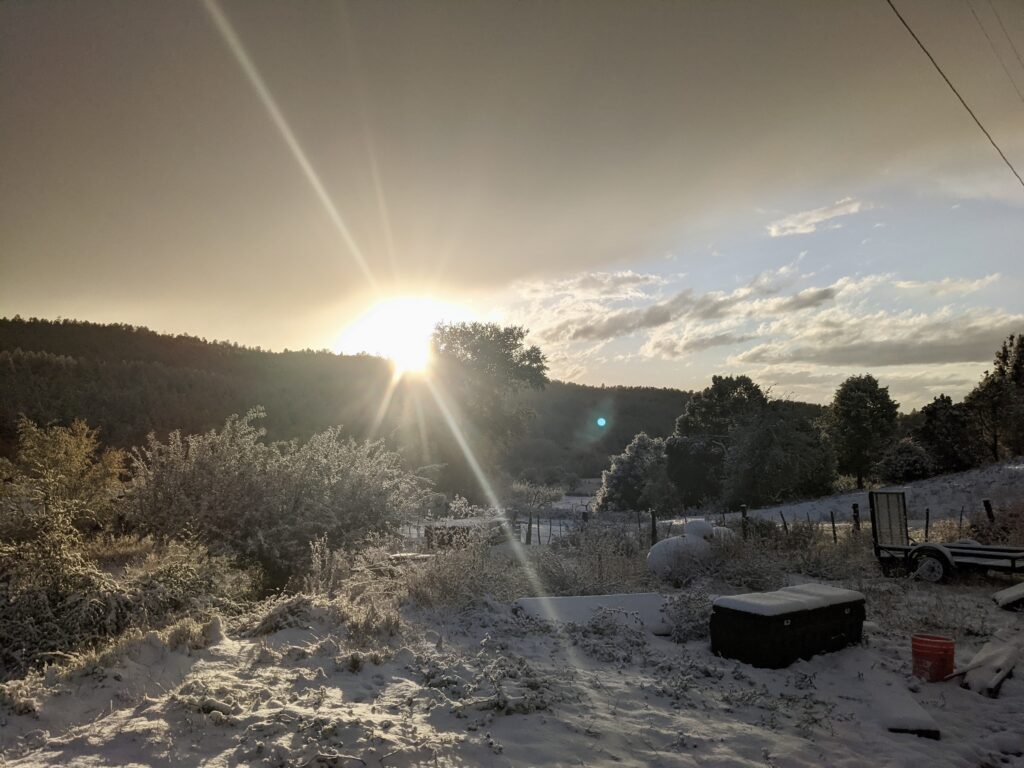
Or I would walk a single-track trail that stretches for many miles and rises thousands of feet up from the dry bushland into the forests of the mountainous plateau where El Valle sits. From the lower elevation, the trail rises over long sections of black rock, then red, then grey-green, then white. I would contemplate the geological eons I was traversing as I climbed in altitude and time, closer and closer to the present as I got higher.
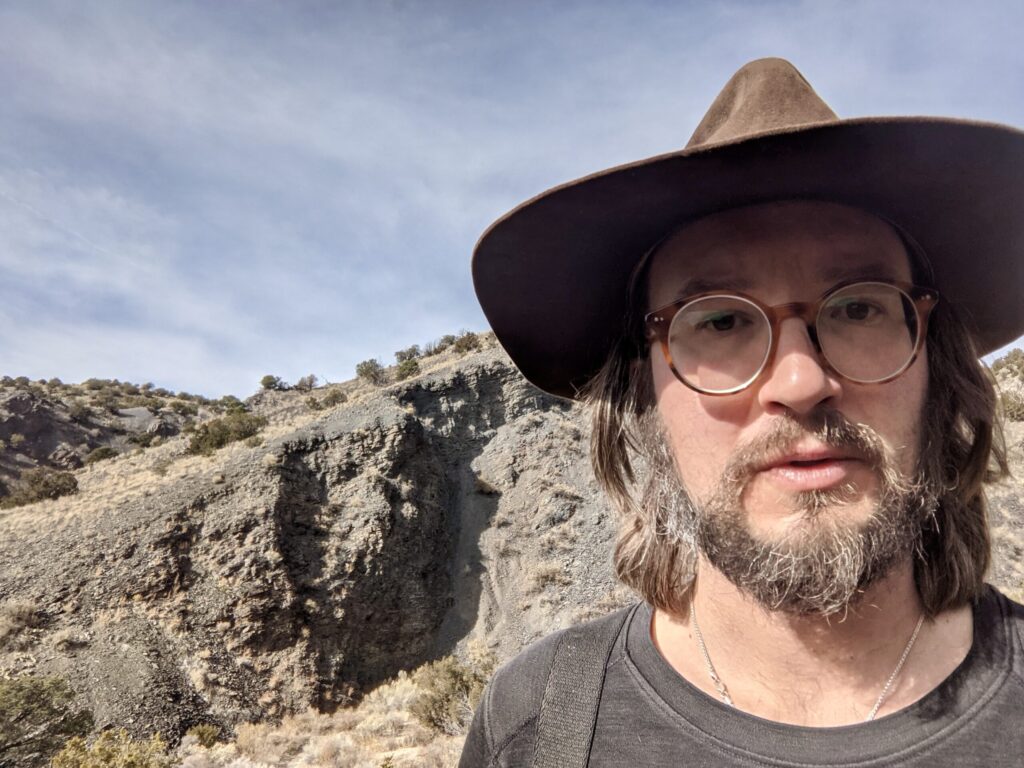
At the top of that trail, lava formations create a semicircle of vertical columns that look like pipe organs. They tower above an enormous chasm that holds swirling thermals that rise from the sun-warmed rock. Birds would ride that column of air until they were specks in the great abyss of sky.
Another trail begins hidden behind an unmarked guardrail and follows a dry streambed through an enormous, alternating steep sides and box canyon. In the morning, the vertical walls of rock on each side act as mirrors, reflecting the sun rising behind you in a million points of sparkling light. I privately referred to this as Cougar Canyon, unable to resist the impulse to name, to allow the mind to do its work of signification.
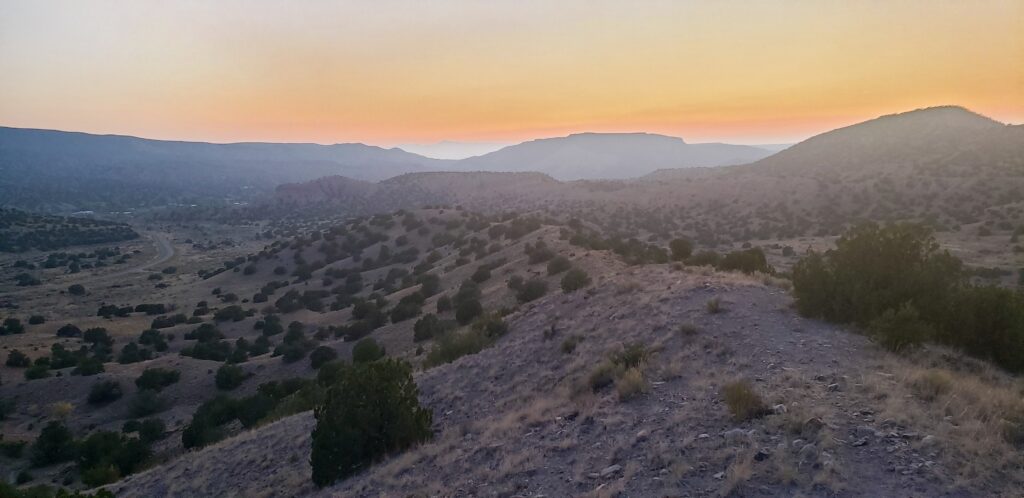
Lower in the valley, the Nambé Badlands compose a five-by-five-mile fenced square. Courses of trails follow long plains which then rise abruptly up striking stone formations. The paths are worn smooth and hard from the bikes and foot traffic, flowing like water through dry, hot lowlands. The formations stand as they have for eons, witnesses to the wind, water, and humans who have swirled through the arroyos there, molding the land into sinuous curves.
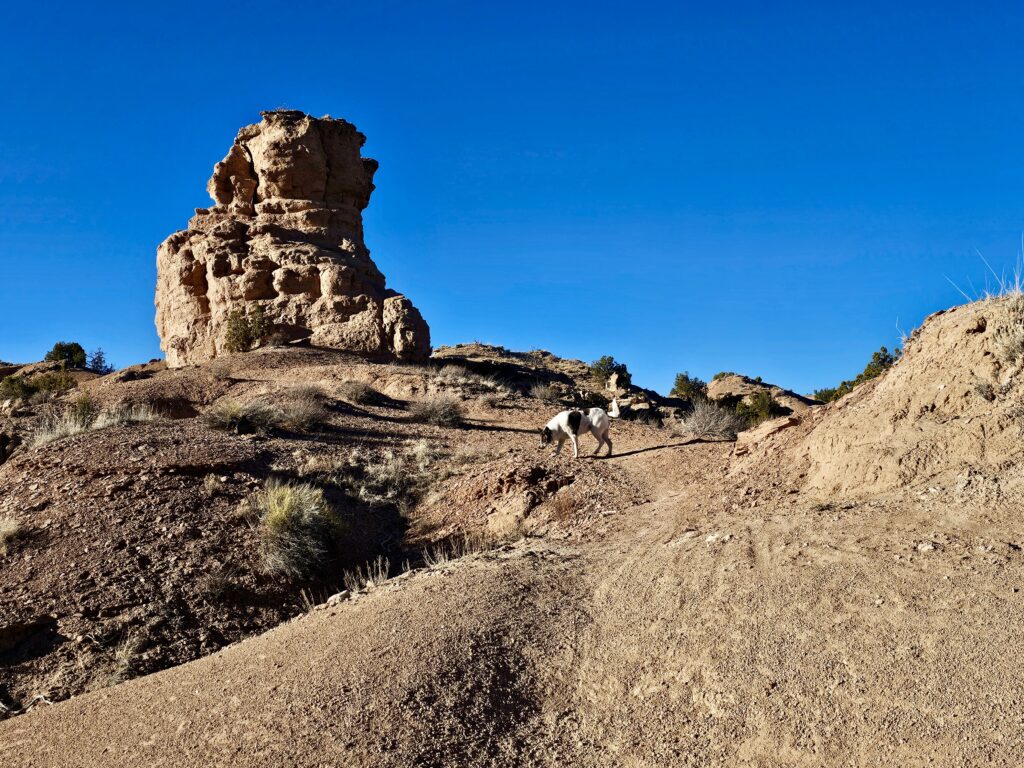
Meandering miles from the highway up the slanted plain to the foothills of the Jemez mountains, a wide creek bed collects the sand eroded from sandstone banks. Enormous granite formations root mini mountains that the stream weaves through on its inexorable path downward. That path has a commonly accepted name, but to me it’s the location of the poem “Silent in the Desert” — my imagination running wild with fabricated stories of an old man I once met on the path, him in his cowboy hat and little dog, and what the lifespan of a human, dog, or cougar means in the context of the kind of time it takes to create such a landscape.
While there, I developed the habit of carrying a notebook and pen when I walked. These notebooks, which I call by their Spanish name “cuadernos,” are simply standard blank paper folded into fourths. I usually eventually add a cover from cardstock, and make a binding from two holes and whatever string I have handy.
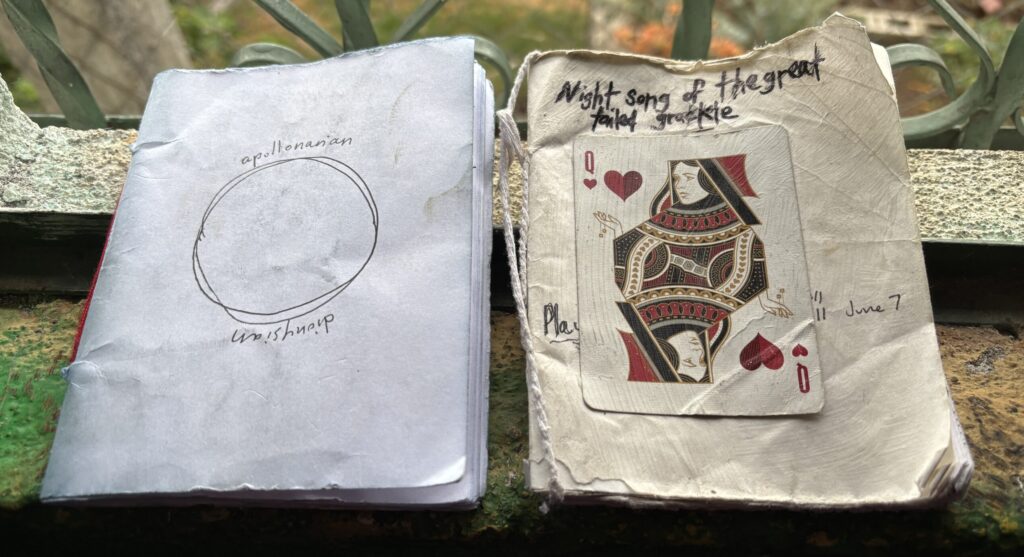
I eventually left New Mexico and the grand scale of the outdoors there for a small apartment in Houston. During that time, I started looking through the stack of notebooks and decided to type out what I had written. I was shocked to find I had enough poetry, and a consistent enough voice and perspective, for a small collection, or maybe even two.
This editing was a process of clarifying and remembering the mindset I’d been in when I wrote them: an attempt to communicate the deeper meanings through a refinement of grammar, syntax, word choice, and order — the nuts and bolts of poetry. This was the first time I understood that what I might have been doing could be called “poetry.”
Dreams of Poetry
How I came to write and compile this collection, whatever my esoteric goals may have been walking in New Mexico, has been a long time coming. From my first impulse towards poetry, my first “yearning,” I have been through decades of phases of creating visual art, songwriting, studying instruments, and working to participate and support natural systems as creative expression. Through all of these, poetry has been a constant companion and love. On looking back, I seem to have learned something deeper from that constant immersion than simple mechanisms of language.
Very early on, I found the collected works of Robert Frost hidden away on a shelf in my parents’ basement. I savored the multiple meanings of words, and the meaning in the spaces between the words. Connected as I felt to the invisible world, poetry spoke to my experience. Emily Dickinson came to me at these early ages as well, modeling the way that poetic symbol can reverberate into the unseen and the unseen can manifest in the physical.
My family was Evangelical Christian, and even as the looming steeple threw some suspicious shadows on poetry books, music, or any other sensual pursuit, I loved the sanctioned poetry of the Bible. As a junior high student, I would get up early and read the wisdom poetry of Proverbs, Song of Songs, or my favorite, Ecclesiastes. It states “Money is the answer to everything,” and presages the unprocessed grief of later existentialists, the anger and sorrow expressed in the theme, “Everything is meaningless.”
I would read certain parts of the Old Testament as well. With Samson, Jonah, or the weird goings-on of Elijah and Elisha, my imagination would run wild. These tales drip with arcane cultural references: the honey of meaning in the lion’s skull of symbol. People fly around the sky, and huge plants grow and die in a day. Somehow, these tales avoided the approbation of the miserable men who wrote and compiled them, perhaps because they are sufficiently, gratuitously bloody: an entire town is slain by a mule jaw in the hands of one man. Or even more likely, because the violence is often in service of control: a group of kids question the authority of a prophet and get mauled by a bear as punishment.
Later, I took a poetry class at University. The teacher, with a pack of Marlboro Reds in his breast pocket, described Apollonian and Dionysian approaches to writing, his haggard look on most mornings indicating he may have been practicing the latter approach. When he learned no one in class had read Howl he stopped class to read — no, perform — Allen Ginsberg’s monumental work. I still remember “boxcars, boxcars, boxcars.”
It was only later that I experienced Howl more accurately, as a rip in the space-time continuum. A couple of times and places, Berkeley and Lawrence, witnessed moments where what seemed most sane as a mission for my life in this crazy world was to distribute “incomprehensible leaflets,” one of his innumerable lines indelibly printed on the windows of my skull.
At this time I was also exposed to the Tao Te Ching, perhaps my favorite work of poetry, philosophy, and politics that I’ve encountered. It had been years since I read this profound work when I wrote “The Cemetery Path,” but my paraphrasing it there indicates the hold it has on me. The Tao Te Ching, combined with Chuang Tzu, connected me to an older wisdom tradition, and one that was very funny and quietly revolutionary.
Chuang Tzu relates a story that the king’s representatives came to him at his humble, rural home to invite him to be an honored member of the royal court. In response, he pointed to a turtle on the edge of the water and asked, “Would this turtle be more happy as a carcass, a display item, in the court, or with its tail in the mud?” He then sent them away saying that he would stay here, at home, with his tail in the mud. This form of rebellion, nonparticipation in dead systems of power in favor of the living natural world, has obvious resonance.
During a time of great personal transition, I became captivated especially by T.S. Eliot’s final contribution, on the reality that undergirds all experience: the seasons; life, death, rebirth; the triple goddess. All of this Eliot explored through a look back on a long life in the towering Four Quartets.
I said to my soul, be still, and wait without hope
For hope would be hope for the wrong thing; wait without love
For love would be love of the wrong thing; there is yet faith
But the faith and the love and the hope are all in the waiting.
Wait without thought, for you are not ready for thought:
So the darkness shall be the light, and the stillness the dancing.
More recently, a friend passed me Illuminations by Rimbaud, a work that explores a dreamworld of consciousness, possessing a coherence and power of mysterious provenance. His haunting line, “Wise music is missing from our desires,” is quoted in “Juniper-Piñon Grove.”
Gary Snyder wrote during the time of the Beat poets, and was interested in consciousness, the mind, and nature. He did not speak to me when I was younger, but as I compiled these poems, I saw a kindred spirit in him and his work. The epigraph of Choreography starts with a quote I overheard while gathering wood for the winter around El Valle, a direct influence of Snyder and his poems quoting the people he heard working as a logger.
In these recent years, I’ve also moved through more contemporary poets, including the absolutely remarkable The Wild Iris by Louise Glück, with plants taking on language. Crystal clear, undefinable entities overlook what: the garden? the people of the garden? other spirits? Humans pass through the gauzy gaze of various vegetable consciousnesses, with their distinct desires and perspectives, warping time and desire as we know it.
The work of Jorie Graham offered a syntax that directly influenced the structure of Choreography of the Living, with the indented verses nested under a leading line. She also found a way to write in a climate emergency. For example, she reports what “the radio says,” finding a way to acknowledge the trauma of living through mass extinctions, catastrophes, and the disembodied, strange feeling of these realities breaking through to everyday life.
We’re driving and the radio says mass marine extinctions within a
generation. No silence, no sirens — an unflustered inflection, then
stock markets, cryptic as Latin mass.
Spending so much time in the wilderness year by year, all throughout the United States, I have witnessed firsthand the slow, erratic creep of ecological collapse. Entire communities are drying up in the mountains of New Mexico where I lived, snowpack measured in single-digit percentages of 70s levels, itself diminished from earlier times. The trees of the mountains are draped in parasitic hanging moss, and the small islands of mountain forests there are being pushed higher before our eyes, the logical conclusion of which is that these massive ecosystems will eventually evaporate off the tips of the mountains. I was unable to contend with these realities in Choreography of the Living, with the possible exception of some of the visions of an apocalyptic social collapse, as in “The Cemetery Path.”
Vision of the Poets
I think that all the wisdom literatures and all the poets are working to put into words the ineffable. Of course, the words themselves are not ineffable — what can be named is not the eternal name — but that’s the magic, that words can transport a person into a mindset, place, or feeling, which is not something that’s summed up with words. This tending to the ineffable is what drew me originally to poetry.
The tradition of listening to the unspoken seems common to all the works of this tradition, as it attempts to elucidate what we can feel and understand, but may lack intellectual or linguistic scaffolding. The old saw, “Poets lie to tell the truth” gets at this: we use language to move beyond language, and use syntax to indicate structures beyond our own understanding. This quality of attention is the deeper, more profound habit I learned from the poets.
The magic that happens with this type of attending is that the world becomes alive, and the poet can become that living world. Looming large over this entire tradition, Walt Whitman, a kosmos, serves as a primary template for the poet who contains and gives voice to all things, as in “Song of Myself”:
O lands! all so dear to me—what you are, (whatever it is,) I become a part of that, (whatever it is,)
Elasticity I am, and I am the dense rock, and I this invisible gas of the air,
I find I incorporate gneiss, coal, long-threaded moss, esculent roots,
And am stucco’d with quadrupeds and birds all over.
Whitman embodies how through observation and imagination everything becomes animate and speaks, even the gas and rocks. Furthermore, he helpfully describes exactly what he’s doing as he does it, a disarming habit perhaps necessary to give context to what might otherwise be a jarring perspective.
Specifically interesting is the way Whitman embodies the body politic: all people, regardless of station, are encompassed and equally given voice. He also moves into what could be called the “body ecological.” I do the same in this collection, giving voice to a mountain system, juniper-piñon grove, and a collection of black cicadas. Biologically alive or not, these elements are all becoming and have a story as much as any human.
For example, by consciously putting myself in a geological context, my consciousness changed. Stones move and mountainsides murmurate, if you sufficiently compress time. The “inanimate” world comes alive and speaks if you approach it in this way, a concept reflected in the opening lines of the first poem: “The stones speak strong if you know how to listen.“
I remember hearing an interview with Mary Oliver in which she said that to do her work early on, she had to live in poverty in order to have the freedom to spend most of her days outdoors, in her case on the seashore, in disciplined waiting for the voices to speak so she could write them down. Such work subverts systems of objectification, in both this immediate case — choosing time outdoors and foregoing money or career striving in favor of this eccentric pursuit — but also literally in the sense that “objects,” as we normally apprehend them, become living, communicating subjects. Such practice is not aimed at speaking the world into existence, the glorious triumph of verse as I sometimes hear people describe poetry. Rather, the goal is to be a subject among subjects, a listener, a secretary, a scribe for trees, stones, wind, and birds.
I have before me Choreography of the Living, my first published collection of poetry. If my graduation to my childhood dream of “poet” has come, it was not, paradoxically, primarily by a focus on writing but on listening. By learning the lessons of the poets and land I have loved, silence and attention allowed language to arise from an animate world, and I became a scribe for the unseen: language pointing beyond itself to subjects who still speak, a choreography of the living.
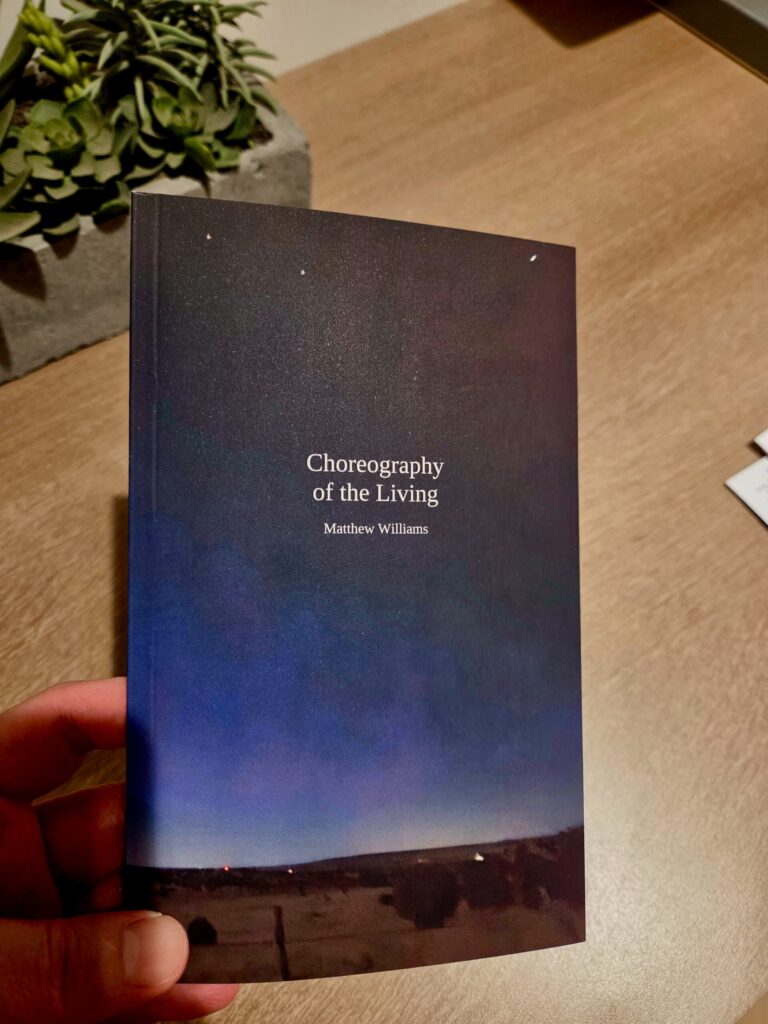
The full poetry collection is available to read online here.